Neukölln
Sonne und BetonNeukölln is more than a setting in the novel: it is the boys’ lived geography, a network of familiar routes and uncertain corners where belonging offers little protection from violence. Its streets carry them between school, home, friends, and danger, while the contrast between Gropiusstadt and North Neukölln shows how local knowledge can be sharply limited even within the same district.
Definition and Geographic Orientation
Neukölln is established as a place of personal and narrative connection. Felix Lobrecht’s biography identifies Berlin-Neukölln as the district where he grew up with two siblings and his father after his mother died in 1993. That biographical detail gives the place an authorial connection, but the narrative scenes also make Neukölln concrete through the characters’ movements and encounters rather than treating it as a mere label.
For Lukas and his friends, Gropiusstadt is the familiar point of reference within this larger urban landscape. Lukas describes Gino as someone who is usually either with the group or under house arrest; he cannot think of a place where Gino might simply be alone. The friends’ shared hope of moving out of Gropiusstadt and into the city when they turn eighteen likewise shows how their sense of the future is mapped onto a change of neighborhood. The city beyond home is imagined as somewhere with more to do, but the immediate story keeps pulling the friends back toward the places and relationships they already know.
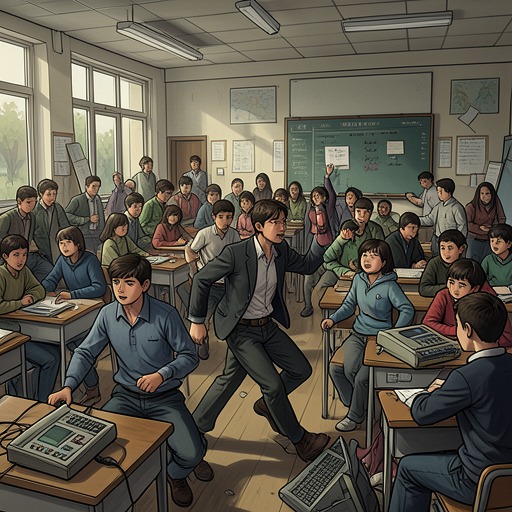
The district is not uniformly familiar. After fleeing a computer shop, Lukas reaches a quieter courtyard entrance and realizes that he does not know where he is: he estimates that he is somewhere between Karl-Marx-Straße and Sonnenallee, in North Neukölln, an area he knows poorly. His heavy backpack holds a computer and monitor, and the objects thump against his back as he runs. The mismatch between the familiar name of the district and his uncertainty about its smaller streets makes geography part of the danger: he has escaped the shop, but has not yet regained control of his surroundings.
Streets, Encounters, and Public Pressure
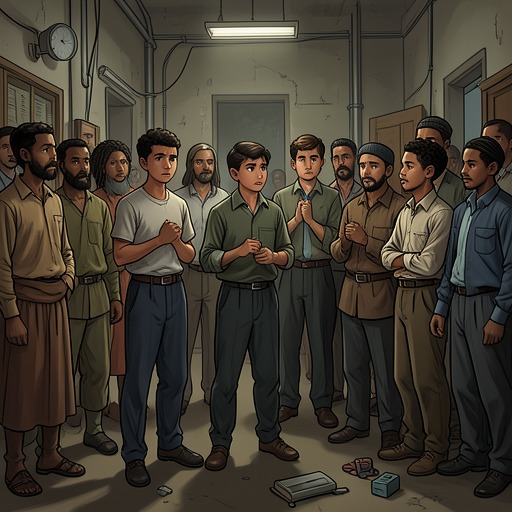
Public places in Neukölln repeatedly turn private decisions into exposed confrontations. Near a kiosk, Marco encounters a group of about seven boys gathered by a U-Bahn entrance. He greets them with handshakes and kisses, then puts an arm around Lukas and introduces him as his younger brother. The group includes Cem’s brothers and members of S44. In this moment, the entrance is both a meeting point and a display of social ties: Marco’s familiarity with the group publicly places Lukas within a network that has its own history and reputation.
A different encounter makes the pressure of being watched more threatening. In a park, Djamel steps out from a crowd and challenges Lukas, who has arrived with a telescopic baton. Lukas freezes, cannot move his legs, and lets the baton slip from his hand. Cem then strikes Djamel with his elbow, splitting his temple, and the gathered groups surge into a fight. The scene’s escalation depends on the public setting: insults and stares precede the blow, while the crowd becomes an immediate audience and then part of the violence. The park is not simply where the fight happens; it is where the boys’ attempts to save face become visible to one another and to the surrounding group.
The characters also anticipate violence before it occurs. Lukas describes parties as following a recurring pattern: music and drinking give way to aggression, after which boys arrive, beat people, take the alcohol, and leave. His forecast is part of his explanation for resisting Sanchez’s insistence on going out. It presents danger not as an isolated surprise but as something the friends expect to recur in social spaces. Gino quietly agrees that the party is a bad idea, while Sanchez presses ahead, so their different responses to the same local prospect reveal a disagreement about risk as well as a disagreement about where to spend the evening.
Routes, Transit, and the Search for Gino
The district’s transport spaces connect its scattered scenes. When Julius explains that Gino’s father has been violent and that Gino may have wanted help escaping the house, the friends get off the U-Bahn in Neukölln and begin to search. At the station, they pass people sleeping between the S-Bahn and U-Bahn levels; one person nearby is inhaling solvent from a plastic bag. They say nothing as they head for the platform. The station is a passage through the city, but here it becomes a pause in which the group has to absorb what Julius has disclosed and decide what they can do.
At Wutzkyplatz, the surroundings offer no immediate clue. The area is nearly empty apart from a few drinkers by the shopping center; lights remain at the station exit while most apartment windows are dark. Julius tries repeatedly to call Gino on Lukas’s phone, but Gino’s phone is switched off. Lukas cannot suggest a likely place to look, and the friends’ familiarity with Gino’s usual routines does not tell them where he has gone. Sanchez proposes walking to Gino’s home and looking for blood that might indicate the direction he fled. The plan is uncertain, but it is the only one they can devise, so they set out together.
Neukölln’s routes thus hold two distinct kinds of uncertainty: Lukas can be disoriented in streets he rarely visits, and the group can be at a familiar station without knowing where their friend is. The city gives them ways to move, but not reliable answers. Its transit connections carry the boys toward home and toward one another, while the search for Gino exposes how little control they have over what happens inside the homes they are trying to reach.
Narrative Significance
Across these episodes, Neukölln is shown through specific locations and actions rather than through a single, comprehensive description of the district. A kiosk and U-Bahn entrance serve as a point of recognition; a park becomes the site of a fight; a courtyard offers temporary cover after a flight; and a station platform becomes a place to plan a search. Their meanings change with the people gathered there and the immediate stakes.
The location also sharpens the contrast between proximity and knowledge. Lukas and Gino have grown up together in Gropiusstadt, and the friends expect to find one another through familiar routines. Yet Lukas does not know North Neukölln well, and none of them knows where Gino is when his phone goes dark. In this way, the district is intimate without being wholly legible: shared neighborhoods and routes sustain friendship, but they cannot make every street safe or every crisis solvable.